Balance Exercises for Seniors at Home | Expert Fall Prevention
Quick Overview:
Balance exercises for seniors at home are simple, effective movements that improve stability, prevent falls, and maintain independence. This comprehensive guide covers safe exercises you can do at home, from beginner to advanced levels, with clear instructions and safety tips.
Regular balance training reduces fall risk by up to 40%, strengthens leg muscles, improves coordination, and boosts confidence in daily activities. Professional mobile physiotherapy providers can assess your current balance, teach proper technique, and create a personalized program that progresses safely at your pace.
Whether you’re experiencing minor unsteadiness or recovering from a fall, starting a balance program today can significantly improve your quality of life. This guide explains what exercises work best, how to perform them safely, when to progress, and how to integrate balance training into your daily routine without special equipment.
Why Balance Matters More as We Age
Balance naturally declines with age, but this doesn’t mean falls are inevitable. Understanding why balance changes helps you take effective action to maintain stability and independence.
Table of Contents
ToggleAfter age 60, several factors combine to affect balance. Muscle strength decreases, joint flexibility reduces, vision changes, and the inner ear’s balance system becomes less responsive. Medications can also impact stability.
The consequences of poor balance extend beyond fall risk. Reduced stability leads to decreased confidence, less physical activity, and gradual loss of independence. Many seniors start avoiding activities they enjoy simply because they feel unsteady.
The Real Cost of Falls
Falls represent the leading cause of injury-related deaths among Australians over 65. Beyond the statistics, falls create fear that limits life.
Even falls without serious injury often trigger a downward spiral. After falling once, many people become anxious about falling again, leading them to move less and avoid activities. This inactivity weakens muscles further, actually increasing fall risk.
The good news: Balance training works at any age. Studies consistently show that regular balance exercises significantly reduce fall risk, even in people who have fallen before.
Understanding Your Balance System
Balance isn’t just about standing steady. It’s a complex system involving multiple body parts working together seamlessly.
Three Systems That Control Balance
Vision: Your eyes provide crucial information about your position relative to your surroundings. This is why balance often worsens in dim lighting or unfamiliar environments.
Inner ear (vestibular system): Small structures in your inner ear detect head position and movement. Age-related changes here contribute significantly to balance problems.
Proprioception: Sensors in your muscles and joints tell your brain where your body parts are positioned. This “body awareness” often declines with age, especially in the feet and ankles.
When these three systems work together efficiently, you maintain steady balance automatically. Problems in any one system can be compensated by the others, which is why targeted exercises help so much.
Professional mobile physiotherapy providers assess all three systems to identify specific weaknesses and create effective treatment plans. This personalized approach produces better results than generic exercise programs.
How Balance Exercises Help Seniors
Balance training provides benefits that extend far beyond preventing falls. Regular practice creates positive changes throughout your body and mind.
Physical Benefits
Stronger leg muscles: Balance exercises strengthen the muscles that keep you upright, particularly in your ankles, calves, thighs, and hips. Stronger legs make every daily activity easier and safer.
Better coordination: Practicing balance movements improves the communication between your brain and muscles. Your body learns to respond faster when you start to lose balance.
Increased flexibility: Many balance exercises gently stretch muscles and improve joint mobility, making movement smoother and more comfortable.
Enhanced reaction time: Regular training helps your body respond more quickly to unexpected situations like stepping on uneven ground or reaching for something.
Mental and Emotional Benefits
Greater confidence: As balance improves, the fear of falling decreases. This confidence allows you to stay active and engaged in life.
Maintained independence: Better balance means you can continue daily activities without assistance, from getting dressed to going shopping.
Reduced anxiety: Knowing you’re less likely to fall brings peace of mind to both you and your family members.
Improved quality of life: The combination of physical capability and mental confidence allows you to participate in activities you enjoy.
Research from Australian universities shows that seniors who complete supervised balance programs report feeling more confident and independent, even beyond measurable physical improvements.
Safety First: Before You Begin
Starting balance exercises requires proper preparation to ensure safety and effectiveness. These precautions protect you while building confidence.
Medical Clearance
Speak with your doctor before beginning any new exercise program, especially if you have:
- Recent falls or near-falls
- Dizziness or vertigo
- Heart conditions or blood pressure issues
- Joint replacements or arthritis
- Neurological conditions affecting movement
- Vision problems
- Recent surgery or injury
Your doctor can identify any specific precautions needed for your situation. They may also recommend working with experienced home visit physio specialists who understand your medical history.
Creating a Safe Exercise Space
Essential safety measures:
- Clear the area of rugs, cords, and clutter
- Ensure good lighting throughout the space
- Position yourself near a sturdy counter or wall for support
- Wear non-slip footwear or grippy socks
- Keep a chair nearby for rest breaks
- Remove pets from the area during exercise
- Have a phone within reach in case of emergency
Never exercise when you feel unwell, dizzy, or overly tired. If you experience pain, chest discomfort, or severe shortness of breath, stop immediately and seek medical attention.
The Importance of Proper Progression
Starting too aggressively is a common mistake that leads to frustration or injury. Balance training should challenge you appropriately without overwhelming your current abilities.
Dedicated in-home rehabilitation experts understand how to progress exercises safely, ensuring each level builds on the previous one. This systematic approach produces lasting improvements without setbacks.
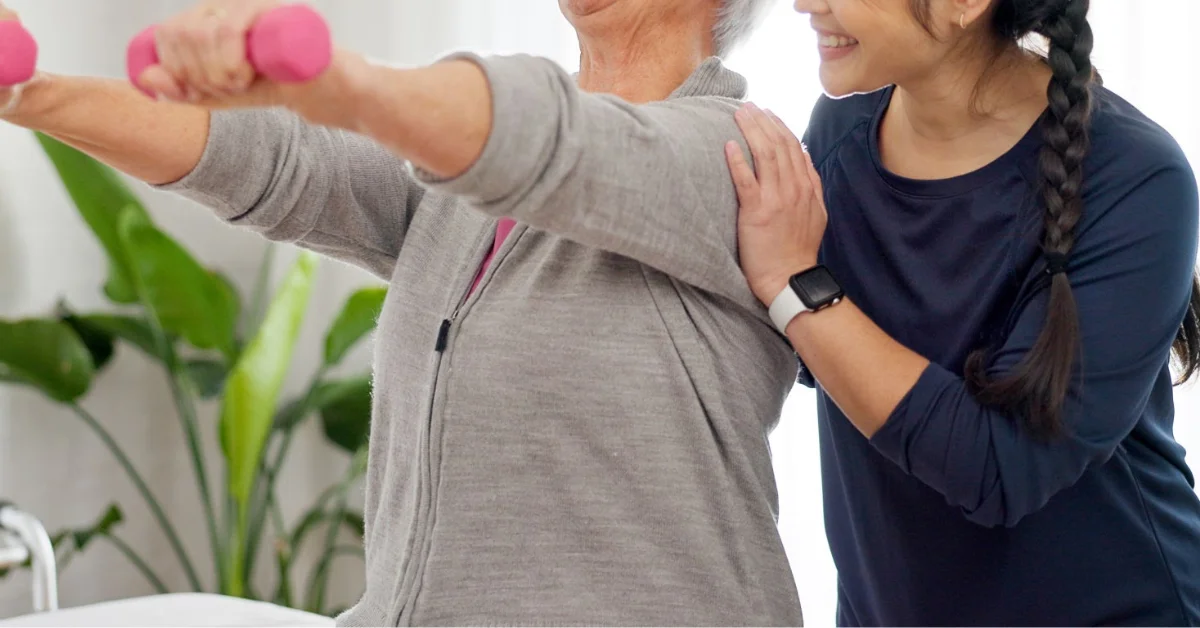
Beginner Balance Exercises for Seniors at Home
These foundational exercises are perfect for anyone new to balance training or those who feel unsteady. Always use support as needed.
Exercise 1: Standing March (Supported)
Stand behind a sturdy chair, holding the back with both hands. Lift one knee toward your chest as high as comfortably possible, then lower it. Repeat with the other leg.
How to do it:
- Stand tall with good posture
- Keep your supporting leg straight but not locked
- Lift your knee slowly and with control
- Hold for 1-2 seconds at the top
- Lower slowly and repeat 10 times per leg
Benefits: Strengthens hip flexors and improves single-leg stability, essential for walking safely.
Exercise 2: Heel Raises
Standing behind a chair with light hand support, rise up onto your tiptoes, lifting your heels as high as possible. Hold briefly, then lower slowly.
How to do it:
- Feet hip-width apart
- Rise up slowly, taking 2-3 seconds
- Hold at the top for 2-3 seconds
- Lower slowly, taking 2-3 seconds
- Complete 10-15 repetitions
Benefits: Strengthens calf muscles crucial for balance and walking. Improves ankle stability and circulation.
Exercise 3: Side Leg Raises
Standing sideways to a chair with one hand on the back for support, lift your outer leg straight out to the side. Keep your toes pointing forward.
How to do it:
- Stand tall without leaning
- Keep your supporting leg slightly bent
- Lift your leg 6-12 inches to the side
- Hold for 2 seconds
- Lower slowly and repeat 10 times per side
Benefits: Strengthens hip muscles that prevent sideways falls, common when turning or stepping sideways.
Exercise 4: Toe Stands
Similar to heel raises but in reverse. Standing with chair support, rock back onto your heels, lifting your toes off the ground.
How to do it:
- Maintain good posture
- Shift weight back slowly
- Lift toes while keeping heels planted
- Hold for 2-3 seconds
- Return to flat feet
- Complete 10 repetitions
Benefits: Strengthens shin muscles and improves ankle flexibility, helping prevent trips.
Exercise 5: Seated Balance Exercises
Sitting provides a safe starting point for those with significant balance concerns. Sit tall on a firm chair without armrests.
Seated marching:
- Lift one knee, then the other, alternating like marching
- Complete 20 repetitions (10 per side)
Seated leg extensions:
- Straighten one leg in front of you, hold for 5 seconds
- Lower and repeat with the other leg
- Complete 10 per side
These seated exercises build strength needed for standing balance work. They’re also excellent for elderly clients who are just beginning rehabilitation.
Intermediate Balance Exercises
Once you can comfortably complete beginner exercises with good form, progress to these intermediate challenges. Reduce hand support gradually as you improve.
Exercise 6: Single-Leg Stand
The gold standard balance exercise. Stand on one leg while maintaining good posture and control.
How to do it:
- Start holding the chair with both hands
- Lift one foot slightly off the ground
- Hold for 10 seconds initially
- Progress to 30 seconds per leg
- Gradually reduce hand support to one finger, then no hands
Progression tips: Once you can balance for 30 seconds without support, try it with eyes closed (always near support) or while turning your head side to side.
Benefits: Mimics the single-leg stance phase of walking. Dramatically improves overall balance and fall prevention.
Exercise 7: Heel-to-Toe Walk
Walk in a straight line, placing the heel of one foot directly against the toes of the other foot with each step.
How to do it:
- Walk along a straight line (use a hallway or line on the floor)
- Keep a wall within arm’s reach for safety
- Take 10-20 steps forward
- Turn carefully and return
- Look ahead, not down at your feet
Benefits: Improves dynamic balance during movement. Strengthens core stability and coordination.
Exercise 8: Clock Reach
Standing on one leg, reach your free leg toward different “numbers” on an imaginary clock face around you.
How to do it:
- Stand on your right leg, holding chair if needed
- Reach your left leg toward 12 o’clock (straight ahead)
- Return to center
- Reach toward 3 o’clock (to the side)
- Continue around the clock face
- Complete 8-12 reaches, then switch legs
Benefits: Challenges balance in multiple directions, improving your ability to recover from unexpected movements.
Exercise 9: Tandem Stance
Stand with one foot directly in front of the other, heel touching toes, as if standing on a tightrope.
How to do it:
- Position feet in a straight line
- Use light chair support initially
- Hold position for 10-30 seconds
- Switch which foot is in front
- Maintain upright posture throughout
Benefits: Narrows your base of support, training your body to balance with less stability. Excellent for real-world situations requiring narrow stances.
Advanced Balance Exercises for Confident Seniors
These challenging exercises are for seniors who have mastered intermediate levels and want to further improve their balance capabilities.
Exercise 10: Single-Leg Stance with Ball Toss
Stand on one leg and toss a small ball or beanbag from hand to hand, or against a wall.
How to do it:
- Balance on one leg near support
- Toss a soft ball between hands
- Maintain balance for 20-30 seconds
- Switch legs and repeat
- Progress to catching against a wall
Benefits: Combines balance with upper body movement and visual tracking, mimicking real-life multitasking scenarios.
Exercise 11: Walking Backward
Walking backward requires even more balance control than forward walking.
How to do it:
- Walk in a hallway with walls on both sides
- Take small steps backward
- Look over one shoulder or use a mirror
- Complete 10-15 steps
- Turn carefully and repeat
Benefits: Engages different muscle groups and challenges your balance system in unfamiliar ways. Improves spatial awareness.
Exercise 12: Balance Walk with Head Turns
Walk in a straight line while turning your head from side to side.
How to do it:
- Walk forward along a hallway
- Turn head to look right, then left with each step
- Maintain straight walking path
- Complete 10-20 steps
- Progress to walking in figure-8 patterns
Benefits: Challenges the vestibular system and improves your ability to maintain balance while your head moves.
Understanding how to prevent falls in elderly individuals requires more than just exercises; it involves comprehensive home safety and lifestyle modifications.
Table: Progressive Balance Exercise Program
| Level | Exercise Examples | Duration | Frequency | Support Needed |
|---|---|---|---|---|
| Beginner | Supported standing march, heel raises, side leg raises | 10-15 minutes | Daily | Full hand support on chair |
| Intermediate | Single-leg stand (10-30 sec), heel-to-toe walk, tandem stance | 15-20 minutes | 5-6 times/week | Light touch support, progressing to independent |
| Advanced | Single-leg with ball toss, backward walking, head turns during walk | 20-30 minutes | 5-6 times/week | Nearby support for safety only |
| Maintenance | Mix of all levels, outdoor walking, stairs | 20-30 minutes | 4-5 times/week | As needed for challenging exercises |
Your Balance Exercise Journey
A Progressive Path to Stability and Confidence
Initial Assessment
Comprehensive home evaluation of your current balance and stability
Personalized Plan
Custom exercise program tailored to your abilities and goals
In-Home Sessions
Guided practice in your familiar, comfortable environment
Progress Tracking
Regular monitoring and program adjustments for optimal results
Long-Term Success
Improved mobility, confidence, and independence
Progressive Exercise Levels
Beginner
- Supported standing march
- Heel and toe raises
- Side leg raises with support
- Seated balance work
- 10-15 minutes daily
Intermediate
- Single-leg stands (10-30 sec)
- Heel-to-toe walking
- Tandem stance practice
- Clock reach exercises
- 15-20 minutes, 5-6x/week
Advanced
- Single-leg with ball toss
- Walking backward safely
- Head turns during walking
- Figure-8 patterns
- 20-30 minutes, 5-6x/week
Key Benefits of Balance Training
Stronger Muscles
Build leg, core, and ankle strength essential for stability and daily activities
Fall Prevention
Reduce fall risk by up to 40% through improved balance and quick reactions
Greater Confidence
Feel secure moving around your home and participating in activities you enjoy
More Independence
Maintain ability to perform daily tasks without assistance or supervision
Home-Based vs Clinic-Based Training
✓ Home-Based Advantages
- ✓ Exercise in your familiar, comfortable surroundings
- ✓ No travel stress or transportation challenges
- ✓ Practice with your actual furniture and layout
- ✓ Family members can participate and learn
- ✓ Flexible scheduling around your daily routine
- ✓ Personalized safety assessment of your home
× Clinic-Based Challenges
- × Travel required, often difficult for seniors
- × Unfamiliar environment can increase anxiety
- × Generic exercises not adapted to your home
- × Limited family involvement in sessions
- × Fixed appointment times and waiting rooms
- × Cannot address specific home safety issues
Creating Your Personal Balance Exercise Routine
Consistency produces results. A structured routine makes balance training a sustainable habit rather than an occasional activity.
Weekly Schedule Template
Monday, Wednesday, Friday:
- Warm-up: 3-5 minutes of gentle movement
- Strength exercises: 10 minutes (leg raises, heel raises)
- Balance exercises: 10 minutes (appropriate to your level)
- Cool-down: 5 minutes of stretching
Tuesday, Thursday:
- Light activity day with functional balance practice
- Walk around your home or neighborhood
- Practice balance during daily activities
Weekend:
- One longer session combining strength and balance
- Outdoor activities if weather permits
- Review progress and plan next week
Tracking Your Progress
Keeping a simple record helps you see improvements and stay motivated.
What to track:
- Date and time of exercise
- Which exercises you performed
- How many repetitions or how long you held positions
- How much support you needed
- How you felt during and after exercise
- Any challenges or concerns
Many people find that reviewing their progress with experienced home visit physio specialists provides valuable feedback and encouragement to continue.
Incorporating Balance Training into Daily Activities
Balance practice doesn’t require dedicated exercise time. Many daily activities provide excellent opportunities to improve stability.
Kitchen Balance Practice
While preparing meals:
- Stand on one leg while washing dishes (hold counter if needed)
- Rise onto tiptoes to reach upper cabinets
- Practice tandem stance while waiting for water to boil
- Walk backward to retrieve items from the refrigerator
These small additions throughout the day accumulate significant practice time without feeling like formal exercise.
Around the House
Simple opportunities:
- Stand on one leg while brushing your teeth
- Practice heel-to-toe walking down hallways
- Do calf raises while talking on the phone
- Step over objects rather than around them (safely)
- Reach in different directions to put away laundry
Making balance training part of your routine ensures consistent practice that leads to real improvements.
Safe Outdoor Practice
Walking outdoors provides natural balance challenges through varied terrain, but requires extra caution.
Outdoor balance practice tips:
- Walk on grass or gentle slopes
- Practice in parks with benches nearby
- Walk with a friend or family member
- Choose well-maintained paths
- Avoid areas with trip hazards
- Consider using a walking aid for confidence
Professional mobile physiotherapy providers can assess your outdoor walking ability and recommend appropriate challenges for your skill level.
When to Progress and When to Seek Help
Knowing when to advance your exercises and when to get professional guidance ensures safe, effective improvement.
Signs You’re Ready to Progress
You should move to more challenging exercises when:
- Current exercises feel easy and comfortable
- You can complete full repetitions with good form
- You rarely need to grab support for stability
- You feel confident and eager for new challenges
- You’ve been at your current level for 2-3 weeks
Progress gradually. Add one new challenge at a time rather than changing your entire routine.
Warning Signs to Watch For
Seek professional help if you experience:
- Dizziness or lightheadedness during exercise
- Sharp pain in joints or muscles
- Numbness or tingling in feet or legs
- Significant shortness of breath
- Chest pain or irregular heartbeat
- Persistent difficulty with beginner exercises
- Multiple near-falls or falls
Sydney’s trusted mobile physiotherapy team can identify underlying issues and adjust your program appropriately. Some balance problems require specific interventions that generic exercises cannot address.
The Value of Professional Assessment
While home balance exercises benefit most seniors, professional assessment ensures your program targets your specific needs effectively.
A physiotherapist can:
- Identify which of the three balance systems needs most attention
- Assess fall risk factors beyond just balance
- Teach proper exercise technique to maximize benefits
- Progress exercises systematically and safely
- Address pain or mobility limitations
- Modify exercises for your specific health conditions
Discover more about what services are offered by a mobile physio and how personalized assessment improves outcomes.
“After my fall last year, I was terrified to move around my own home. The physiotherapist came to me and taught me exercises right in my living room where I felt safe. We started so gently, but within a few weeks, I noticed I could stand to cook dinner without holding the counter. Now, three months later, I’m walking to the shops again. Having someone guide me through it at home, at my own pace, made all the difference. I actually look forward to my exercises now.”
– Dorothy M., 76, Sydney
Common Mistakes to Avoid
Even with the best intentions, common errors can limit your progress or increase injury risk. Being aware helps you exercise more effectively.
Mistake 1: Progressing Too Quickly
Enthusiasm is wonderful, but patience produces better results. Advancing before you’re ready increases fall risk and discourages continued effort.
Give each level at least two weeks before progressing. Your body needs time to adapt and build strength.
Mistake 2: Poor Posture During Exercises
Slouching or leaning compromises both safety and effectiveness. Stand tall with shoulders back and core engaged during all exercises.
If you cannot maintain good posture during an exercise, it’s too advanced for your current level. Return to easier variations.
Mistake 3: Holding Your Breath
Many people unconsciously hold their breath during challenging balance exercises. This raises blood pressure and reduces oxygen to muscles.
Breathe naturally and rhythmically throughout all exercises. If you notice you’re holding your breath, the exercise is probably too difficult.
Mistake 4: Exercising on Unstable Surfaces Too Soon
While advanced balance training includes unstable surfaces like foam pads, beginners should master firm-ground exercises first.
Progress systematically from firm floors to slightly unstable surfaces only after achieving consistent success at your current level.
Mistake 5: Skipping Warm-Up
Jumping straight into balance exercises on cold muscles increases injury risk. A brief warm-up prepares your body for the challenges ahead.
Spend 3-5 minutes walking around your home or doing gentle movements before balance work.
Understanding proper technique and progression is where aged care physio services add tremendous value through expert guidance.
Equipment to Support Your Balance Training
While balance exercises require minimal equipment, a few simple items can enhance safety and effectiveness.
Essential Items
Sturdy chair: A heavy, stable chair without wheels provides reliable support. Dining chairs often work well.
Non-slip mat: Prevents sliding on smooth floors. Exercise mats or yoga mats provide cushioning and grip.
Proper footwear: Non-slip soles are crucial. Athletic shoes with good support or grippy socks work well. Avoid exercising in regular socks on smooth floors.
Optional but Helpful
Full-length mirror: Provides visual feedback on posture and form. Position it where you can see yourself during exercises.
Tennis ball or beanbag: Useful for advanced exercises involving catching and throwing while balancing.
Resistance bands: Add strength-building components to your balance routine.
Timer or watch: Helps track hold times for static balance exercises.
You don’t need expensive equipment or a gym membership. Most effective balance programs use simple, household items. This is one reason why at-home physiotherapy works so well for seniors.
Balance Exercises for Specific Conditions
Certain health conditions require modified approaches to balance training. Always consult healthcare providers about condition-specific considerations.
After Hip or Knee Replacement
Joint replacement surgery improves mobility but requires careful balance retraining. Post-surgical exercises focus on strengthening the new joint while improving stability.
Start with seated exercises and progress gradually under professional supervision. Learn more about physiotherapy after hip replacement for specific guidance.
With Arthritis
Joint pain can make balance exercises uncomfortable, but modified versions remain beneficial. Focus on gentle, controlled movements within comfortable ranges.
Discover how managing arthritis at home with physiotherapy helps maintain mobility while reducing pain.
After Stroke
Balance problems are common after stroke. Specialized stroke rehab exercises address one-sided weakness and coordination challenges unique to stroke recovery.
With Neurological Conditions
Conditions like Parkinson’s disease, multiple sclerosis, or neuropathy require specialized balance approaches. Neurological physiotherapy addresses these complex needs with expert techniques.
The Role of Strength Training in Balance
Balance and strength are interconnected. Weak muscles cannot support good balance, regardless of how much balance practice you do.
Key Muscle Groups for Balance
Ankles and calves: Provide the first line of defense when you start to tip. Strong ankles make quick corrections possible.
Quadriceps and hamstrings: These thigh muscles control knee stability and generate power for standing from seated positions.
Hip muscles: Particularly important for preventing sideways falls. Hip strength allows quick stepping to catch your balance.
Core muscles: Your trunk muscles maintain upright posture and coordinate movements between upper and lower body.
Simple Strength Exercises
Incorporate these strength-builders alongside balance work:
- Chair squats: Stand from a chair and lower back down slowly (10-15 repetitions)
- Wall push-ups: Build upper body and core strength (10-15 repetitions)
- Leg extensions: Straighten and lower each leg while seated (10 per side)
- Seated row: Pull resistance band toward chest (10-15 repetitions)
A comprehensive program addresses both balance and strength for optimal fall prevention.
Taking the Next Step Toward Better Balance
Improving balance doesn’t require expensive equipment or gym memberships. What it requires is commitment, consistency, and proper guidance to ensure safe progression.
Starting a balance exercise program today can prevent falls tomorrow. Every session builds strength, improves coordination, and increases confidence. The exercises in this guide provide a solid foundation for independent practice.
However, professional guidance optimizes your results. An expert assessment identifies your specific weaknesses and creates a targeted program that addresses your unique needs. This personalized approach produces faster, more comprehensive improvements than generic exercise routines.
Why Choose Mobile Physiotherapy for Balance Training
In-home balance assessment and training offers distinct advantages over clinic-based services:
Personalized safety: Your physiotherapist evaluates your actual home environment and addresses specific hazards you encounter daily.
Convenience: No travel stress or transportation challenges. Treatment comes to you at times that suit your schedule.
Comfort: Exercise in familiar surroundings where you feel most secure and confident.
Family involvement: Loved ones can participate in sessions, learning how to support your balance training between visits.
Practical application: Practice balance exercises using your own furniture and spaces, making skills immediately transferable to daily life.
Professional mobile physiotherapy providers bring expertise directly to your home, eliminating barriers that prevent many seniors from accessing the care they need.
Conclusion
Balance exercises for seniors at home represent one of the most effective fall prevention strategies available. Regular practice strengthens muscles, improves coordination, and builds the confidence needed to maintain an active, independent lifestyle.
The exercises outlined in this guide provide a progressive pathway from beginner to advanced levels. Start where you are, practice consistently, and progress gradually. Small improvements accumulate into significant enhancements in stability and quality of life.
While independent practice benefits most seniors, professional assessment and guidance optimize your results while ensuring safety. Expert physiotherapists identify specific balance deficits, teach proper technique, and progress your program systematically.
Don’t let fear of falling limit your life. Take control of your balance through regular exercise and appropriate professional support. The strength and stability you build today protects your independence tomorrow.
Ready to improve your balance and reduce fall risk? Visit Health Next Door to learn more about personalized balance assessment and training programs delivered in the comfort of your home across Sydney, Brisbane, and the Gold Coast.
Take the first step toward better balance today. Contact our experienced team to schedule a comprehensive in-home balance assessment. Professional guidance ensures you exercise safely while achieving the best possible results.
You Can Find All Answers Here
Most seniors notice initial improvements within 2-4 weeks of consistent daily practice. You might first observe better confidence or steadiness during familiar activities. Measurable improvements in standardized balance tests typically appear after 4-6 weeks. However, balance training is ongoing; the real goal is continuous maintenance and gradual progression rather than reaching a fixed endpoint. Professional mobile physiotherapy providers can track your progress objectively and adjust your program to ensure steady improvement. Remember that consistency matters more than intensity. Doing 15 minutes daily produces better results than one hour weekly.
Absolutely. In fact, balance exercises are especially important for people who rely on walking aids. Your exercise program should be adapted to include your assistive device while also working to improve the underlying balance and strength. Many exercises can be modified to perform while holding your walker or cane for support. The goal is improving your stability within your current capabilities, not necessarily eliminating the need for assistive devices. Sydney's trusted mobile physiotherapy team can design a program that works with your walking aid while gradually building confidence and ability. Safety always comes first, so appropriate support is encouraged throughout your training.
It's never too late to improve balance, even after multiple falls. Research shows that seniors who have fallen can significantly reduce their future fall risk through targeted exercise programs. However, after experiencing falls, professional assessment becomes especially important to identify contributing factors beyond just balance. These might include medication side effects, vision problems, home hazards, or underlying health conditions. Experienced home visit physio specialists can evaluate your complete situation and create a safe, progressive program that rebuilds both physical ability and confidence. Many people who have fallen develop a fear that limits their activity, which actually increases fall risk. Professional guidance helps break this cycle safely.
No, skip balance exercises on days when you feel dizzy, lightheaded, unwell, or unusually fatigued. Exercising when you don't feel well increases injury risk and could indicate underlying health issues that need medical attention. If dizziness occurs frequently, speak with your doctor about possible causes such as medication side effects, inner ear problems, or blood pressure issues. Some causes of dizziness, particularly vestibular disorders, benefit from specialized vestibular rehabilitation physiotherapy. This targeted approach addresses dizziness at its source rather than just working around it. Always prioritize how you feel over maintaining a rigid exercise schedule.
While general balance exercises benefit most seniors, certain situations require professional evaluation. Seek expert assessment if you experience frequent near-falls or falls, sudden changes in balance ability, dizziness or vertigo, numbness in feet or legs, difficulty with basic beginner exercises after several weeks of practice, or balance problems that limit your daily activities. Professional assessment identifies specific balance system deficits that generic exercises might miss. Dedicated in-home rehabilitation experts use standardized tests to measure your current abilities and track improvements objectively. They can also identify and address underlying causes of balance problems, such as medication effects, vision issues, or specific neurological conditions requiring specialized treatment approaches.
Get Physio Care at Home – No Waiting, Just Relief!
We bring expert physiotherapy directly to your door, with no hassle or long wait times. Our skilled, NDIS-approved physiotherapists are here to help you feel better, faster.
Health Next Door, we bring mobile physiotherapy to your doorstep, ensuring a patient-centric approach that prioritizes your needs and goals. Our experienced physiotherapists assess your condition and create a personalized therapy plan, helping you recover in the comfort of your home with expert care tailored just for you. With our comprehensive mobile physiotherapy services, you get professional treatment for pain relief, injury recovery, and mobility improvement—all without leaving your home. Experience convenient, high-quality care designed to fit your lifestyle.
View All Articles